Published Date:
12 August 2009
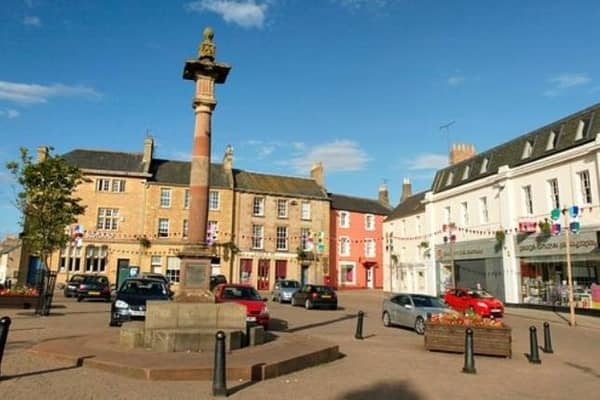
HUNDREDS of cheering well wishers lined Coldstream's High Street on Thursday, as a 300-plus cavalcade began the annual ride out to Flodden Field to commemorate the notorious bloody battle of 1513.

After last year's ride was greeted by torrential rain, strong winds and flooding, the highlight of Coldstream's civic week was due some good weather, and with bright sunshine and temperatures soaring into the 20s, they certainly got it.
The ceremonial duties began when the 2009 Coldstreamer, Craig Telford, and his attendants - right-hand man Ricky Hope and left-hand man Gareth Watson, followed pipers into the town's Market Square. There the 15th Earl of Home, whose ancestors led the Borders into battle in 1513 at Flodden, charged Craig to carry the Home colours to Flodden and to return it "unsullied and untarnished".
The Earl, flanked by two Coldstream Guards and with the Countess by his side, also charged Craig to cut a sod of earth from the battlefield and return it safely to Coldstream, to commemorate the actions of those who brought back the bodies of the Scots noblemen to be buried in consecrated ground.
This year's Flodden Day marked a special occasion for two of the riders taking part - Peter Scott made this year's pilgrimage 50 years after winning the Smail Cup in 1959 for the youngest rider, and Hamish Brown also took part, making it his 50th annual Flodden Day ride-out.
The mounted cavalcade made their way along the High Street, out of the town and up to Flodden memorial, where a gathered group awaited the arrival of the principals to remember the dead from both sides of the border.
Craig, flanked by his right and left hand man, slowly made his way up the steps at the side of the field and along to the memorial, following piper Robert Bell. A short service was conducted by the Reverend Malcolm Lockey, who said that the Scots and the English now stand side by side to honour the memory of their dead. The fallen of the battle of Flodden from both England and Scotland were remembered, as well as those who gave their lives in later conflicts, including the World Wars, and thoughts were spared for those who continue to fight today.
The Coldstreamer laid a blue and white wreath against the memorial and the last post was played by Peter Meikle, a bugler with the Royal Coldstream Guards.
The principals then re-joined the rest of the cavalcade for the traditional gallop to the top of Branxton Hill, where a huge crowd waited to cheer the riders. Craig proudly led the procession up the hill-side, raising the Burgh Standard to cheers from both riders and spectators, which competed with the thundering thumps of the horses hooves. The noise echoed round the hillside as glorious sunshine beat down and the temperatures tipped 22 degrees.
The events of September 9, 1513, were then remembered in a service on Branxton Hill, where the congregation took their seats to remember the fallen. An address of welcome was given by the chairman of the Presenting Coldstream Association, Jim Leifer, who welcomed everyone to the annual service, before the Reverend Linda Gardham led the congregation in prayer.
Then it was time for the oration, delivered this year by historian Paul Thompson, who overcame his nerves to deliver an interesting and informative account of the famous battle.
Paul, who lives in Belford with his wife and son, hails from Rothbury and is described as a 'True English Borderer'. Employed as caretaker of Ford Castle, he has undertaken a 12 year study of the Battle of Flodden and took part in a recent archaeological dig at Flodden Hill.
Some of his ancestors were Border reivers and it is very likely that they fought at the Battle of Flodden as light cavalry and foot soldiers.
In his oration, Paul looked at the run up to the famous battle, saying: "It is important to look at the history behind the battle of Flodden.
"King James IV and King Henry VIII started with a very good relationship. When King Henry was crowned his sister, Margaret, was married to James IV of Scotland.
"It was only after a couple of years that the relationship between the two countries began to decline. The first instance occurred when the Lord Admiral Howard of England captured two pirates in the English channel - unfortunately these 'pirates' were not pirates, they were in fact two of King James' Scottish navy ships.
"The troubles continued when King Henry was asked to join the Holy League to fight against France. The Holy League consisted of the papal states Spain and Venice as well as the Emperor Maximilion, and with Henry on board the League surrounded France, cutting her off from the rest of the world.
"Henry invaded France and began to win battles. The Queen of France then invoked the old alliance between Scotland and France by sending a turquoise ring to James, charging him to take three steps into England and strike a blow for her. She also sent money, a large quantity of 18ft pikes (which were used by the Scottish army to keep their formation) and troops to teach the Scots how to fight with them."
Paul explained that James then invaded England and captured the castles of Wark, Norham, Etal, and Ford.
In response the Earl of Surrey, the Royal Treasurer and Lieutenant of the North, with his sons Lord Admiral Howard and Edmund Howard, came north to Newcastle, then to Alnwick, to build an army designed to drive out the Scots. They had arranged to fight the Scots before Friday, September 9 at a location between Wooler and Milfield, without advantage to either side as was the custom of the times. Yet when they reached Wooler they discovered the Scottish were camped on Flodden hill.
On September 6, Surrey sent a message to James, saying that he "was surprised that it hath pleased you to change your promise and put yourself into a ground more like a fortress or camp". James was annoyed by this and sent a reply the following day stating: "It beseemed not an earl after that manner to handle a King" and rather strangely that he "would use no sorcery nor had no trust of any land".
On Thursday, September 8 Surrey moved his army from Wooler to Barmoor. They were running out of food and beer and were forced to drink water. James sent his highlanders on foot to spy on the English. They reported that Surrey had left to go to Berwick.
Paul told the congregation that James did not know what to make of the English army's move north, but believed that Surrey was either going to get reinforcements from Berwick and invade Scotland, try to cut James off from the border, or maybe besiege Flodden hill.
James decided to move the Scottish army from Flodden hill and return across the border. They prepared to leave and set fire to the camp on Flodden hill, setting off on the only route they could take to get back over the border because of the size of the Scottish cannon, which was along the ridge of Branxton Hill.
The Earl of Surrey had decided to cut James off from Scotland. He split his army into two battalions, one commanded by his sons Lord Admiral Howard and Edmund Howard. They took the English cannon and marched from Barmoor to Twizel Bridge and then to Branxton. This was a huge move in one day, that would probably have been thought of by the Scots as impossible.
As the first battalion arrived led by Surrey's sons, the rearguard also arrived, commanded by the Earl of Surrey himself. He had crossed the River Till at Sandyford - since he had no cannon he did not need to use a bridge to cross the river and had had less distance to travel.
The English arrived at Branxton Moor at the same time as the Scots were moving along the ridge at Branxton hill. The battle could not be avoided by either side and what followed was the long and bloody battle that cost Scotland most of their ruling class and the army that fought at Flodden.
-
Last Updated:
12 August 2009 2:18 PM
-
Source:
n/a
-
Location:
Berwickshire